The system that replaces burner domains with trust.
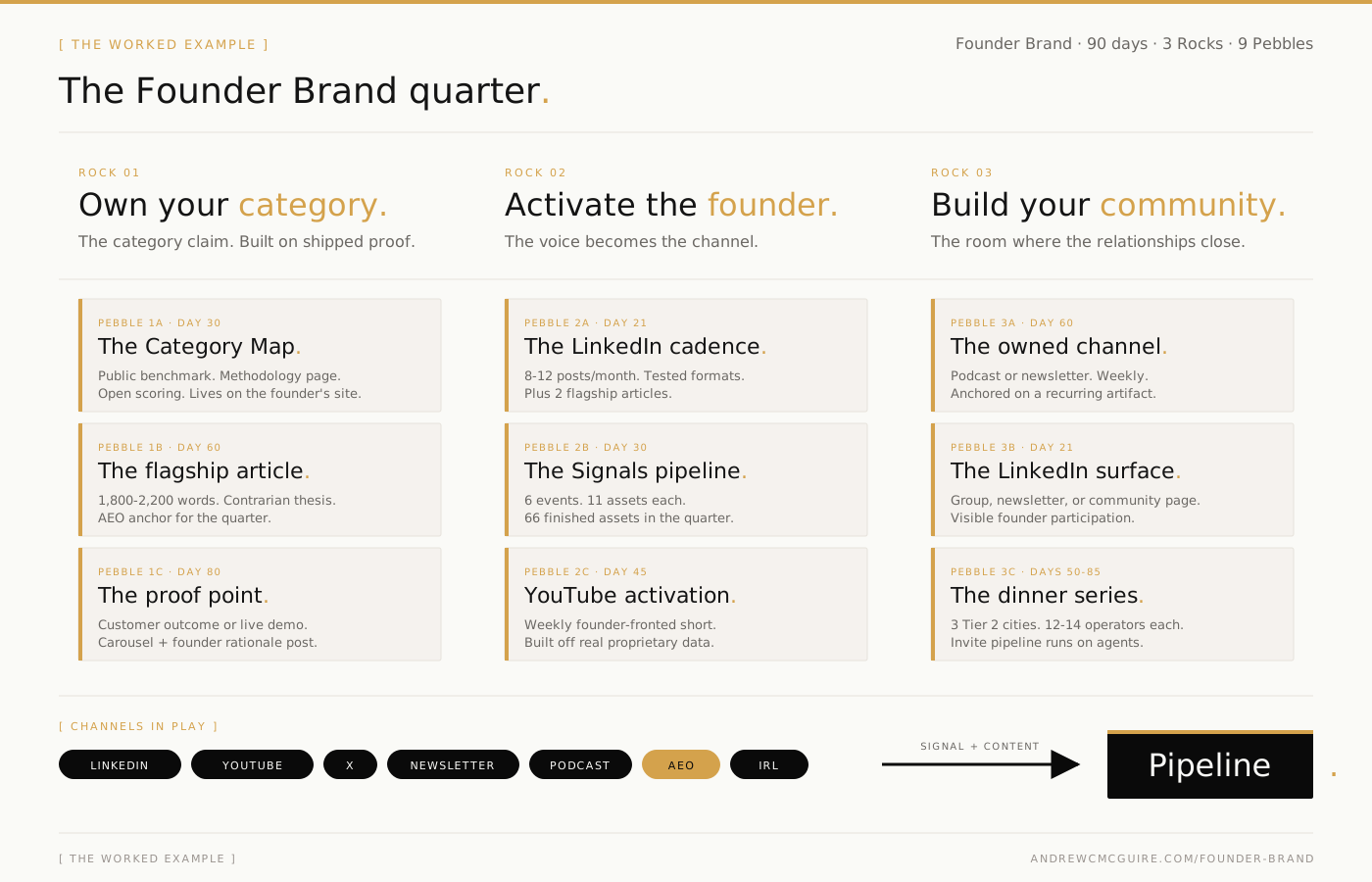
The /operating page covers the methodology. This page is a worked example. Three Rocks. Nine Pebbles. Five tentpole dates. The success metrics. The risks. The decisions.
If you're a founder reading this and thinking “I want to run my quarter like this,” that's the offer. If you're a marketing leader thinking “I want this capability in-house,” that's also the offer.
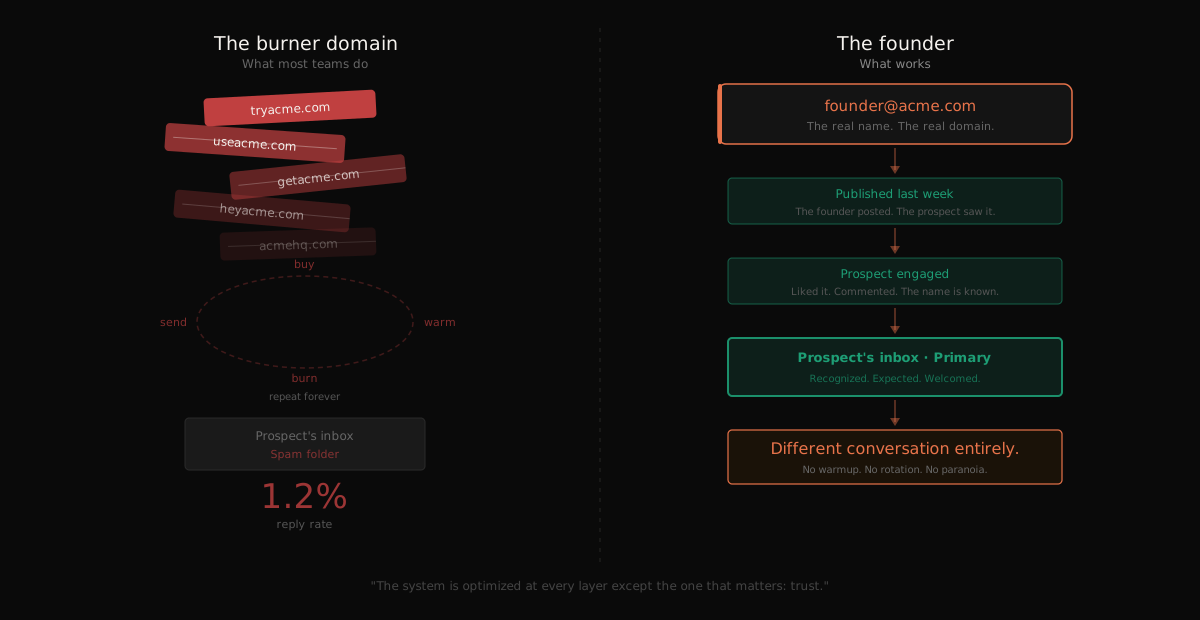
Here's how most B2B companies run outbound in 2026: they buy a lookalike domain — tryacme.com, useacme.com, getacme.com. They warm it up for two weeks with fake email volume. They load it into Smartlead or Instantly. They fire hundreds of sequences per week from an address their own CEO wouldn't put on a business card.
When the domain gets blacklisted, they burn it and buy another one. When the new one gets flagged, they rotate again. Deliverability teams monitor spam scores the way Jason Bourne checks exits — constantly, paranoid, knowing it's a matter of time before they're caught.
The industry calls this “outbound infrastructure.” It's a burner phone for email. And the whole time, everyone involved knows the truth: you wouldn't need any of this if the person on the other end recognized the sender's name.
That's not a tooling problem. It's not a copy problem. It's not an enrichment problem. It's a trust problem. And it's upstream of everything else in the GTM stack.
The fix: make the founder the top of funnel. When the founder has been publishing, when the prospect has already seen their name and their point of view, when the message comes from the founder's actual email about something the prospect actually engaged with — that's a different conversation entirely. Not because the copy is better. Because the trust already exists.
Gal Aga, CEO of Aligned. 519 LinkedIn posts. Averaging 490 likes and 94 comments per post. His company's pipeline runs on the attention his content creates. No lookalike domains. No warmup tools. No deliverability paranoia.
Austin Hughes, VP Growth at Unify. 571 LinkedIn posts. 7.4 posts per month. His team generates $139M in annualized pipeline from signal-based plays run by 2 people. The signals start with founder content. The outbound follows the signal.
Adam Robinson, CEO of RB2B. Built the company to $5M ARR without a dollar of ad spend. His LinkedIn is the entire top of funnel. The pipeline is downstream of the trust his content creates.
Different companies. Different categories. Different stages. Same architecture: founder publishes, signal surfaces, pipeline follows. None of them need a burner domain because the trust is already there when the first message lands.
Three workstreams running in parallel. They share resources, share content, share a single approval date.
Founder = voice. Brand = proof. Community = compounding loop. Category = the claim.
The job: claim your category before any competitor lands the same claim.
The job: turn the founder's voice into a media engine the brand amplifies, the way HubSpot did with Dharmesh from 2006 forward.
Most founders post inconsistently. They mean to. They don't have time. The agents fix that. The founder still owns the voice. The system owns the cadence.
8 to 12 posts per month at tested formats:
· Milestone plus counterintuitive thesis
· Specific person story
· Builder identity
· Data observation
Plus 2 flagship articles in the quarter.
Six branded events in the quarter. Each event produces 11 finished assets:
· 2 founder posts
· 1 brand carousel
· 1 blog post
· 2 X posts
· 1 YouTube short
· 1 newsletter section
· 1 earned-media pitch
· 1 internal summary
· 1 sales snippet
66 finished assets total. Every event becomes an entire content week.
The job: build the surface your customer community gathers on. Owned by the founder, powered by the same system that ships the content.
Most categories have a fragmented community. Pieces live on Slack, in newsletters, on LinkedIn, in someone else's podcast. The founder's job is to build the surface that consolidates them.
Three Tier 2 cities. 12 to 14 named operators per dinner. Co-host where it makes sense.
Tier 2 over NYC and SF is the deliberate call. Lower saturation, higher peer-novelty, lower no-show rate, better video because the room reacts more. The founder in a room with 14 people who've never met them is higher-signal than 14 who've been at three category-adjacent dinners this quarter.
Invite pipeline runs on agents. Ingests the founder's LinkedIn first-degree graph, scores for ICP fit, dedupes against CRM, drafts personalized invites in the founder's voice. Human-approved, never autonomous. Dossier deck for the founder's morning prep on each dinner day.
| Day | Event | What ships |
|---|---|---|
| Day 30 | Category Map v1 | Benchmark goes live. Methodology page. Founder launch post. |
| Day 45 | YouTube cadence live | Weekly short shipping consistently. First 3 episodes have built a baseline. |
| Day 60 | The flagship article | Load-bearing 1,800 to 2,200 word piece publishes. AEO anchor for the quarter. |
| Day 75 | First Tier 2 dinner | Founder in the room with the first cohort. Video captured. Content compounds. |
| Day 90 | Quarter retrospective and Category Map v2 | "90 days of [your category]" article. Benchmark v2 with new entrants scored. Owned channel pilot recap. |
If any one of these slips, the rest slips with it. Approval at Day 0 protects Day 30.
| Metric | Q1 baseline | Q2 target |
|---|---|---|
| AI citations of the founder in category queries | Most queries miss | 70%+ queries cite |
| Founder monthly LinkedIn impressions | Pre-system baseline | 3x baseline |
| Founder LinkedIn articles | 0 | 2 |
| Founder LinkedIn posts per month | Inconsistent | 8 to 12 |
| Brand average engagement | Baseline at Day 0 | +50% lift |
| Pipeline tagged source=founder | 0 | 12 to 20 qualified opportunities |
| Category Map inbound (competitors disputing) | 0 | 3+ |
| Dinner waitlist | 0 | 60+ across 3 cities |
Pass mark: 70% of targets hit. The retrospective article publishes Day 90 either way. Below 50% triggers a re-scope for the next quarter.
It's the highest-stakes single piece of writing in the quarter. If it lands flat, the rest of the cadence is harder to defend. Mitigation: editorial conversation locked before Day 45. Built off real founder data, not a clever hook.
Engineering capacity to ship the benchmark harness. Roughly 2 weeks of one engineer's time. If the capacity isn't available, the Map ships with hand-scored entries and the open-source harness moves to the next quarter.
One named brand-team person picks the founder's top post Tuesday morning, writes the reshare with brand-side context, ships by Tuesday afternoon. 13 weeks straight. If it isn't someone's job description for the quarter, the play doesn't work.
If you're running a three-way co-host moment with two partners, three calendars, three legal teams, three press desks. Mitigation: Agent Operator runs project management directly with all three. Weekly sync starting Day 30. If it slips past Day 75, ship the founder-only version with partners as quote sources.
Most plausible response: a competitor positions themselves as the bank-grade option, the enterprise option, the safe option. The Category Map front-runs that by setting the scoring criteria first. Whoever defines the rubric wins the comparison.
If the founder can't make a city, the dinner still runs but the room's gravity drops. A credible second seat is named in advance for any city the founder can't make.
| Decision | By | Owner |
|---|---|---|
| Three-doc approval (Rock 1, Rock 2, Rock 3) | Day 1 | Founder + GTM lead |
| Engineering capacity for the Category Map | Day 5 | Eng lead |
| Brand-team owner for the Tuesday reshare ritual | Day 5 | Brand lead |
| Field marketing alignment on the dinner series | Day 8 | GTM + Field lead |
| Co-host outreach on dinner cities | Day 8 | Agent Operator |
| Flagship article editorial process locked | Day 8 | Founder + GTM + Operator |
| YouTube format decision | Day 10 | GTM lead |
| LinkedIn community surface platform decision | Day 12 | Operator + GTM |
| Legal review of Category Map methodology | Day 14 | Legal |
I'm Andrew McGuire. I run this quarter end to end.
The platform underneath is forked OpenClaw, rebuilt for this. Five agents in production: Writer, Designer, Editor, Researcher, Router. One operator. Every workflow gets announced in Shipped first.
The methodology lives at andrewcmcguire.com/operating. The proof lives in Shipped, every Friday.
Every Friday in Shipped. The app I built that week, the lesson it taught me, and one prompt you can steal. New SOPs published there first.
Subscribe to Shipped. →